Australia grapples with tobacco tax hike fallout
A New South Wales parliamentary inquiry has concluded that hiking Australia’s tobacco excise tax hasn’t deterred smoking – only the purchase of legal tobacco. As illicit trade, crime, and revenue losses mount, the country is becoming an unwilling “poster case” for what’s wrong with the WHO’s high tobacco tax model.
Twice in eight days this August, Australian parliamentary committees reached the same uncomfortable conclusion: the country’s world-leading tobacco tax has stopped working as intended.
“The whole thing has been a disaster, and it’s been getting worse and worse,” Australian harm reduction pioneer Alex Wodak tells Snusforumet.
On 20 August, a New South Wales inquiry found that current excise levels are “not acting as a deterrent to smoking, but rather a deterrent to smoking legal tobacco.” On 28 August, a federal Senate inquiry recommended pausing further increases altogether.
Neither recommendation has been accepted in Canberra.
A market moving underground
Since 2010, Australia has repeatedly raised tobacco excise – first by 25 percent, then 12.5 percent annually from 2013 to 2020, followed by another 5 percent a year from 2023 to 2025.
A pack of 25 cigarettes that cost $13 AUD in 2010 can now cost up to $60 AUD.
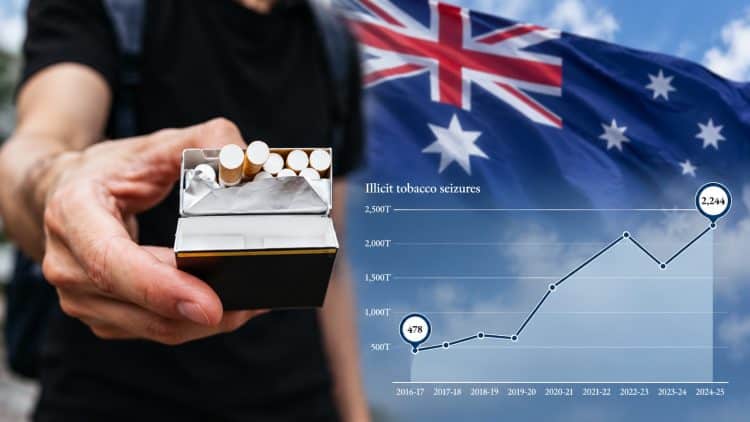
Illicit tobacco has filled the gap. ABS wastewater analysis found that illicit sources’ share of total tobacco consumption rose from 12 percent in 2017 to 80 percent in 2025.

Excise revenue has collapsed alongside it – from $16.27 billion AUD in 2019-20 to $7.77 billion in 2024-25. Treasury’s revised estimate for 2025-26 is just $4.13 billion, according to Commonwealth Budget papers.
Meanwhile, organised crime has moved in. Victoria alone has recorded more than 200 arson attacks on tobacco retailers since 2023, while the NSW inquiry heard of more than 270 firebombings nationally, along with multiple homicides.
Textbook WHO policy
When Canberra announced its 2017–2020 round of 12.5 percent annual increases, the Treasury department explicitly cited the WHO benchmark.
The WHO Framework Convention on Tobacco Control describes tobacco taxation as its single most cost-effective tobacco control measure. Its Article 6 guidelines recommend taxes equivalent to at least 75 percent of a cigarette pack’s retail price.
Australia, in other words, has followed WHO orthodoxy about as faithfully as any wealthy country with strong institutions and border enforcement.
Yet illicit tobacco now accounts for an estimated 80 percent of consumption.
“What Australia has done is it’s made itself a poster case for other governments, researchers, and policymakers to see what happens when extremism is carried out,” Wodak explains.
Patrik Strömer, Secretary General of the Association of Swedish Snus Manufacturers, believes the implications extend far beyond Australia.
“If the WHO’s flagship tobacco-tax recommendation produces an outcome like this in one of its most compliant members, it begs the question whether the policy makes sense at all,” he tells Snusforumet.
Understanding the impact
Despite mounting evidence of unintended consequences, Australian Treasurer Jim Chalmers has ruled out reversing course.
“I don’t believe that unwinding recent changes in excise would fix the longstanding challenge that we have with illegal tobacco,” he said in December.
But even NSW Labor Premier Chris Minns has broken ranks, calling the “massive” excise a driver of the price gap fuelling illegal sales.
Australia’s health agency, the AIHW, argues that the fundamental policy objective is being achieved. Daily smoking has fallen to 5.6 percent, its lowest recorded level.
“Daily smoking rates have more than halved over the past two decades,” said AIHW’s Louise Gates, pointing to sustained progress in reducing smoking.
But researchers who gave evidence to the NSW inquiry question how much of that decline can be credited to excise.
Dr Edward Jegasothy of the University of Sydney testified that if smokers were as price-sensitive as claimed, the sharp acceleration in tobacco taxes from 2010 should also have produced a visible acceleration in the decline in smoking.
It didn’t.
Even the Illicit Tobacco and E-cigarette Commissioner, Amber Shuhyta, doubts a price cut would help.
“There’s no evidence in front of me that, even if we made regulated products $30 or $20, people wouldn’t still opt for a $10 packet,” she testified during a February NSW parliamentary hearing.
Sweden and New Zealand chose differently
Sweden and New Zealand both came up repeatedly in evidence to the NSW inquiry – and both complicate a purely price-based theory of tobacco control.
Sweden’s cigarette taxes are among the lowest in the Nordic region, yet its daily smoking rate is below 5 percent – the WHO’s own “smoke-free” threshold and the lowest rate in the EU by a wide margin.
Researchers told the NSW committee that overall nicotine use in Sweden is roughly in line with the EU average. The difference is that Swedish consumers have largely shifted from cigarettes to snus and other smoke-free nicotine products.
“Swedes didn’t give up cigarettes because they were too expensive,” says Strömer.
“Sweden actually has the cheapest cigarettes in Scandinavia and the lowest smoking rates, proving WHO wrong. It’s access to less harmful options like snus and nicotine pouches, not taxes, that helped Swedes quit smoking.”
New Zealand offers another example.
After legalising regulated retail vape sales in 2020, its daily smoking rate fell from 14.5 percent to 6.8 percent by 2023 – roughly twice the pace of Australia’s decline over the same period.
“New Zealand adopted a very sensible approach of deciding that they had to make the safer option easier to get than the more dangerous option,” says Wodak.
Learning from Australia’s mistakes
Strömer sees Australia’s experience as a test of the WHO’s theory at national scale.
“It’s sad to see how bad things have become in Australia, but also very instructive,” he says.
“It’s a live experiment that proves you can’t tax smoking out of existence.”
Instead, he argues for risk-based taxation combined with legal access to safer nicotine products – an approach he says can cut smoking while protecting tax revenues and limiting the black market.
“Both New Zealand and Sweden show what happens when policy supports access to alternatives rather than a more WHO-inspired prohibitionist approach,” he says.
“We can only hope that policymakers elsewhere don’t have to learn this the hard way like Australia has.”